


If you have tried medication after medication for depression and still do not feel like yourself, TMS therapy is worth knowing about, and NYC providers like Holme Wellness are making it accessible to people who are ready to try something different.
TMS therapy represents one of the most significant advances in depression treatment in recent decades. It offers a genuine alternative for people who have struggled with antidepressants, whether because they did not work, caused intolerable side effects, or they simply left them feeling like a different version of themselves. At Holme Wellness in NYC’s Flatiron district, TMS is part of an integrative approach to mental health that treats the whole person.
Keep reading to know more about
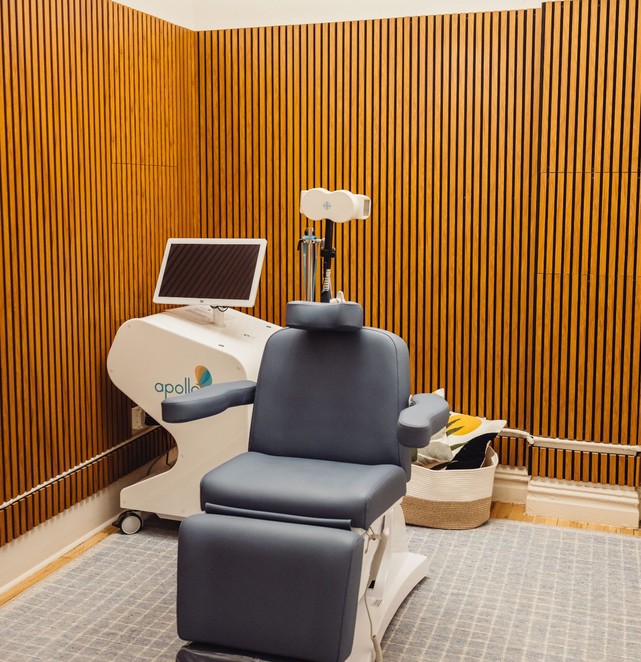
What Is Transcranial Magnetic Stimulation (TMS)?
Transcranial Magnetic Stimulation, or TMS for short, is an FDA-approved, non-invasive treatment for depression and other mental health conditions. It has been approved since 2008 and proven effective in over 30 clinical studies. Instead of medication, it uses gentle, targeted magnetic pulses directed at the part of the brain responsible for mood regulation which is the dorsolateral prefrontal cortex.
No drugs, no systemic side effects, no downtime. You come in for a session, remain awake, alert, and seated comfortably, then return to your normal day immediately afterward. This outpatient treatment does not require anesthesia or sedation and involves no recovery time. Most patients find sessions easy to tolerate, with minimal discomfort; for some, the most common side effect is a brief headache.
The magnetic pulses used in TMS are similar in strength to those used in an MRI, and the procedure works through electromagnetic induction. They stimulate underactive neurons in the mood-regulation area of the brain, gradually improving how that region communicates with the rest of the brain’s mood and emotion circuitry, with a strong safety profile.
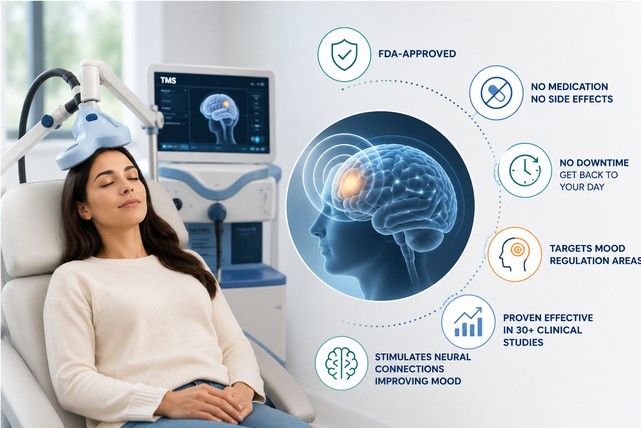
How Does TMS Work?
Your initial visit at Holme Wellness includes a consultation where the clinical team will evaluate your eligibility and use personalized brain mapping to identify areas of the brain to stimulate based on your specific needs. This means treatment is designed specifically for your brain and delivered through an individualized plan from the very first session.
From there, you come in for 18-minute sessions five days a week over six to seven weeks, finishing with a short taper phase to help your results stick, although many protocols run for four to six weeks. The full course is approximately 36 sessions, and while a standard course is often about 30 sessions over six weeks, many people find this schedule fits easily into a workday with very little disruption. Session length is shorter here because Theta-Burst Stimulation is the faster delivery system used to target specific parts while maintaining therapeutic outcomes.
During each session, you will hear a clicking sound and feel a tapping sensation on your scalp during the procedure. You remain awake and alert throughout. Most people read, listen to music, or simply relax during the session.

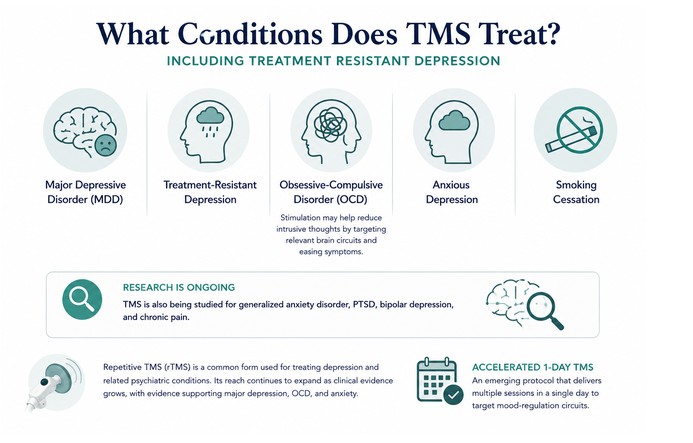
What Conditions Does TMS Treat, Including Treatment Resistant Depression?
TMS is FDA-approved for a broad range of conditions beyond major depressive disorder, and clinicians also use it when evaluating anxiety disorders and related concerns:
- Major depressive disorder (MDD)
- Treatment-resistant depression
- Obsessive-compulsive disorder (OCD), where stimulation may help reduce intrusive thoughts by targeting relevant brain circuits and easing symptoms
- Anxious depression
- Smoking cessation
Research is also ongoing for TMS applications in generalized anxiety disorder, PTSD, bipolar depression, and chronic pain. Repetitive TMS (rTMS) is a common form used for treating depression and related psychiatric conditions. Its reach continues to expand as clinical evidence grows, with evidence supporting major depression, OCD, and anxiety, and with accelerated 1-Day TMS emerging as a protocol that delivers multiple sessions in a single day to target mood-regulation circuits.
Who Qualifies for TMS Therapy?
TMS tends to be a great fit for many people who have not responded to traditional antidepressants and may benefit from a non-invasive option, especially those who:
- Have tried two or more antidepressants without finding real relief
- Struggle with medication side effects that feel like a trade-off not worth making
- Are looking for a path to recovery that does not involve more medication
- Have depression that has not fully responded to therapy alone
- Want a treatment that fits into a normal daily schedule without downtime, which can be helpful for quality of life
TMS is also a strong option for people who cannot tolerate antidepressants due to medical conditions, pregnancy considerations, or interactions with other medications. It can be a helpful choice for people seeking symptom relief without adding more medication, and some begin to feel improvement within a few weeks, though results vary from person to person and can affect daily life.
Who Should Not Pursue TMS?
TMS is not suitable for everyone. People who are not candidates include:
- Patients with metallic implants near the head, including cochlear implants, deep-brain stimulators, or aneurysm clips
- People with implanted electronic devices such as pacemakers or medication pumps
- Individuals with a personal history of seizures or epilepsy
- People who are pregnant (TMS is generally not recommended during pregnancy)
A consultation with the Holme Wellness team is the best way to determine whether TMS is appropriate for your situation. Our psychiatrists review your full medical history, and neurologists may also be involved when there is a neurological history or concerns about implants or seizures, before recommending any treatment. Once candidacy is determined, we explain the next steps for your care.
What to Expect From TMS Results and Side Effects
Most people begin noticing relief from depression symptoms, along with changes in mood, sleep, and energy levels, within the first two to three weeks of treatment. The full benefit of TMS typically emerges over the complete course of treatment and continues to develop for several weeks after the final session.
Studies show that approximately 50 to 60% of patients with treatment-resistant depression experience significant improvement with TMS, and around one-third achieve full remission. For people who have tried multiple antidepressants without success, these are meaningful odds.
Some patients benefit from maintenance TMS sessions after the initial course, typically one session every few weeks or months to track progress over time and sustain their results.
Why Holme Wellness for TMS Therapy in NYC?
Holme Wellness is an integrative mental health clinic in the Flatiron district of Manhattan, serving New York and NY patients seeking TMS care. Our board-certified psychiatrists oversee every TMS treatment course with a clinical approach that prioritizes your individual response and comfort, using an individualized, multidisciplinary team approach grounded in compassionate care. Patients in New York City often compare providers across multiple locations, and Holme Wellness serves patients from across the city from our Flatiron office.
TMS at Holme Wellness does not exist in isolation. It is part of a broader mental health ecosystem and range of services that includes ketamine therapy, psychiatry, medication management, nutrition, yoga, and wellness. So if TMS is part of your treatment plan, it works alongside everything else you are receiving.
We are currently accepting new patients for TMS consultations.
Ready to find out if TMS is right for you? Schedule a consultation with Holme Wellness today.
Frequently Asked Questions
Is TMS therapy painful?
TMS is not painful for most people. During the session, you will feel a tapping or clicking sensation on your scalp and hear a rapid clicking sound, but the procedure is easy for most patients to tolerate, highly effective, safe, and does not involve surgery. Some people experience mild discomfort or a headache during their first few sessions as they adjust to the stimulation; this is usually brief and is among the most common side effects. This typically fades as treatment progresses. The sensation is unusual but not painful in the way that injections or procedures are, and it is not a form of pain management.
How long does it take for TMS to work?
Most patients begin noticing changes in mood, sleep quality, or energy levels within two to three weeks of starting treatment, though how quickly treatment works varies from person to person. Some people notice improvements earlier. The full benefit of TMS usually emerges over the complete treatment course and can continue developing for several weeks after the final session.
Can I drive after a TMS session?
Yes. Unlike ketamine therapy or medications that cause sedation, TMS has no effect on alertness or coordination. You can drive yourself to and from sessions and return to work or normal activities immediately after each appointment.
Does TMS work if antidepressants have not helped me?
Yes, TMS is specifically indicated for treatment-resistant depression, meaning depression that has not responded adequately to antidepressant medications. For some patients, it is considered before more intensive options such as electroconvulsive therapy, though the right treatment still depends on clinical needs. Because TMS works through a completely different mechanism than medication, stimulating neurons directly rather than adjusting brain chemistry through drugs, it can be effective for people who have not responded to multiple antidepressants.
How many TMS sessions will I need?
A standard TMS course consists of approximately 36 sessions delivered five days a week over six to seven weeks, followed by a taper phase. The exact number of sessions is tailored to your individual response. Some people benefit from maintenance sessions after the initial course to sustain results.
Is TMS covered by insurance?
TMS is FDA-approved for treatment-resistant depression and is covered by many major insurance plans, including Medicare, when specific criteria are met, typically after two or more antidepressants have failed to produce adequate relief. Coverage varies by plan and provider. The team at Holme Wellness can help you understand your coverage options during your consultation.
Can TMS be combined with medication or therapy?
Yes. TMS can be used alongside antidepressants, mood stabilizers, and psychotherapy. In fact, many patients continue their existing medications during TMS treatment and combine it with regular therapy sessions. At Holme Wellness, our integrated team coordinates care across all of your providers to ensure the best possible outcome.